Deconstructs the “electrolytic restoration” of your vehicle’s power source: Battery Terminal and Contact Corrosion Cleaning. To achieve AutoFix Mastery, a Master knows that a single layer of “white gunk” (lead sulfate) or “blue-green crust” (copper sulfate) creates electrical resistance that can lead to slow cranking, dim headlights, and alternator strain. In 2026, as vehicle electronics become more sensitive to voltage drops, a Master knows that a poor connection is often misdiagnosed as a dead battery. You need the neutralizing power of a baking soda battery cleaner to safely stabilize acidic leaks or the tactical precision of a battery terminal cleaner spray with acid indicator that turns color to pinpoint exactly where the invisible acid resides.
A Master knows that “electrical dominance” speaks through the $100\%$ conductivity of a wire-brushed terminal, the long-term seal of a NOCO NCP2 protector, and the careful distinction between neutralizing a lead-acid car battery (using a base) and an alkaline electronic battery (using an acid).
NOCO Step 1 Battery Cleaner with Acid Indicator and Step 2 NCP2 Battery Corrosion Preventative CRC Battery Cleaner with Acid Indicator 12 oz Aerosol Carquest Battery Terminal Post and Wire Brush Cleaner Tool NOCO M401 Battery Treatment Kit with Brushes and Protectors Chemical Guys Total Interior Cleaner and Protectant for Battery Trays Gunk Battery Terminal Cleaner 5 oz Schumacher Electric Battery Terminal Cleaning Tool High-Grade Isopropyl Alcohol 99% for Electronics Cleaning Cotton Swabs and Microfiber Detailing Set ON AMAZON
[ ⚡ CLICK HERE TO SHOP BATTERY CLEANING KITS ON AMAZON ]
2026 Electrical Contact Restoration Matrix
In the world of AutoFix Mastery, we categorize cleaning methods by “Chemical Neutralization and Mechanical Abrasion.” A Master knows that cleaning battery contacts corrosion in a TV remote requires the opposite chemistry of a car battery.
| Target Type | Corrosion Type | Neutralizing Agent | Master Tool |
| Car Battery | Acidic (Lead-Acid) | Baking Soda (Base) | Wire Post Brush |
| Electronics | Basic (Alkaline) | Vinegar / Lemon Juice (Acid) | Cotton Swab |
| Pro-Grade | Heavy Build-up | CRC / NOCO Spray | Acid Indicator Foam |
Mastery Deep Dive: The Connection Pillars
1. The Traditional Standard: Baking Soda
For the “Master on a Budget,” baking soda battery corrosion treatment remains a foundational skill. A Master knows that a mix of one tablespoon of baking soda to one cup of water creates an alkaline solution that neutralizes sulfuric acid on contact. You will see it “fizz” as it works. Using baking soda to clean car battery terminals is the best way to clean battery post surfaces without introducing harsh industrial chemicals into your engine bay.
2. The Professional Edge: Acid Indicators
To achieve AutoFix Mastery, use tools that “talk” to you. The CRC Battery Cleaner with Acid Indicator is a Master’s Choice because the yellow foam turns pink upon contact with acid. A Master knows that even if a terminal looks clean, microscopic acid residue can still exist. These sprays, like the Gunk battery terminal cleaner, not only neutralize the acid but also include surfactants that dissolve the “gunk” more effectively than water-based pastes.
3. The Mechanical Protocol: Wire Brushes
Chemistry alone isn’t enough. To achieve $100\%$ conductivity, you must utilize a battery terminal post and wire brush cleaner tool. A Master knows that the “inside” of the cable clamp and the “outside” of the battery post must be shiny silver before reconnection. The male/female design of a standard Schumacher or Carquest brush ensures a perfect $360$-degree scrub without damaging the soft lead of the posts.
4. Electronics vs. Automotive: The Great Switch
A Master knows the “Reverse Rule.” Clean battery corrosion in electronics (like a key fob or remote) usually involves Alkaline batteries (Potassium Hydroxide), which is a base. Therefore, you use a mild acid like vinegar to neutralize it. For a car battery, you are dealing with Acid, so you use a base like baking soda. For a final finish, a Master always uses $99\%$ Isopropyl Alcohol to remove any moisture or residue from delicate electronic contacts.
Master’s Tech Tip: The “Safety Disconnect” Protocol
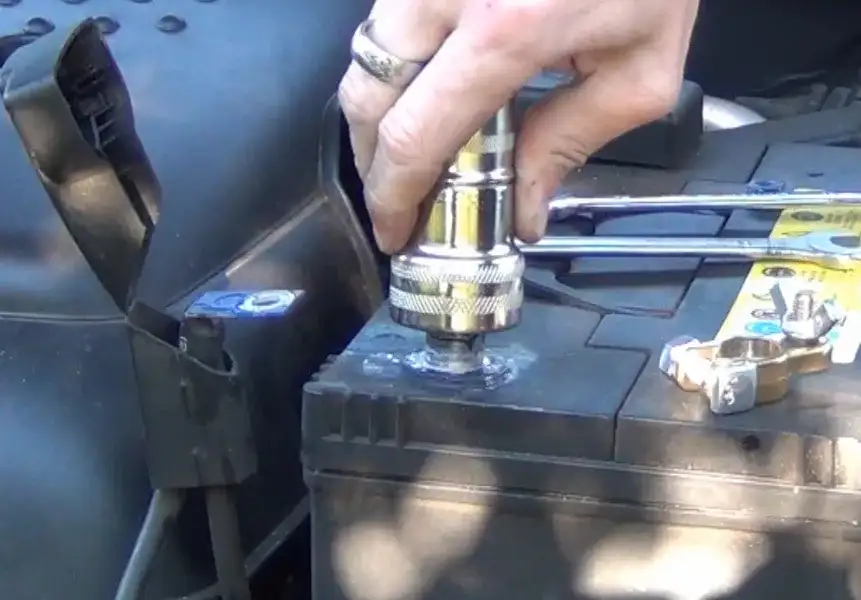
To achieve AutoFix Mastery, respect the circuit. Master Tip: Always disconnect the Negative (–) Black cable first, then the Positive (+) Red. A Master knows that if your wrench touches the car’s body while loosening the positive terminal, it will create a massive spark (short circuit) if the negative is still attached. When cleaning is finished, reverse the order: Positive first, then Negative. This prevents the frame of the car from being “live” during the critical reconnection phase.
[ 🏁 SECURE THE SPARK – SHOP BATTERY CLEANERS ON AMAZON ]
Final Verdict: The Guardian of the Electrical Circuit
Battery maintenance is the most underrated task in automotive care. Whether you are using a baking soda battery terminal paste for a quick fix or a professional Gunk battery terminal cleaner for a deep detail, prioritize “Neutralization” and “Protection.” In the world of AutoFix Mastery, we prioritize NOCO for their two-step “Clean & Protect” system and CRC for their instant acid detection.
Master the connection. Master the start. Be the master of the battery terminal cleaner.
Disclosure: As an Amazon Associate, I earn from qualifying purchases. Electrical precision for a master-maintained machine!