Deconstructs the “acoustic envelope” of your vehicle: Automotive Sound Barriers and Thermal Insulation. To achieve AutoFix Mastery, a Master knows that a quiet cabin isn’t just about luxury; it’s about reducing driver fatigue and providing a “black” background for your sound proof car stereo to perform. In 2026, as Electric Vehicles (EVs) make road and wind noise more apparent, a Master knows that a single-layer approach is obsolete. You need a triple-layered strategy: a Constrained Layer Damper (CLD) like Dynamat Xtreme to kill metal resonance, a “decoupler” like 3M Thinsulate SM600L to absorb high-frequency airborne noise, and a Mass Loaded Vinyl (MLV) barrier to block heavy road hum.
A Master knows that “sonic dominance” speaks through the $150$ to $400$ investment in a full cabin kit, the tactical use of car bonnet sound deadening to quiet diesel clatter, and the logic that Great Stuff expanding foam is for stationary home gaps—never for cars, where its rigid structure can trap moisture and cause hidden rust.
Dynamat 10455 Xtreme Bulk Pack 36 Sq Ft Self-Adhesive Sound Deadener 3M Thinsulate SM600L Acoustic Thermal Automotive Insulation 60" x 10' Noico 80 mil 36 sq ft Car Sound Deadening Mat Butyl Automotive Sound Deadener Noico Red 150 mil 36 sq ft Car Sound Insulation Liner Heat and Cool Barrier Kilmat 80 mil 36 sq ft Car Sound Deadening Mat Butyl ResoNix CLD Rectangles High Performance Sound Deadening Siless Liner 157 mil 36 sq ft Car Sound Insulation and Thermal Foam Design Engineering 050130 Boom Mat Engine Side Fire Wall Black 1" Thick Sound Deadener ON AMAZON
[ ⚡ CLICK HERE TO SHOP CAR SOUNDPROOFING ON AMAZON ]
2026 Acoustic & Thermal Matrix
In the world of AutoFix Mastery, we categorize materials by “Function: Damping, Blocking, or Absorbing.” A Master knows that placing a foam sheet over a vibrating door panel without a butyl base is like trying to stop a bell from ringing by putting it in a pillowcase.
| Material Type | Primary Function | Primary Zone | Master Advantage |
| Butyl Mat (CLD) | Stop Vibration | Floor, Doors, Roof | High-mass butyl kills “tinny” panel resonance. |
| 3M Thinsulate | Sound Absorption | Headliner, Pillars | Hydrophobic (resists mold); ultra-lightweight. |
| Mass Loaded Vinyl | Sound Blocking | Firewall, Floor | The only material dense enough to stop tire hum. |
| Heat Shield Foam | Thermal Barrier | Bonnet, Firewall | Reflects $90\%$ of radiant engine heat. |
Mastery Deep Dive: The Insulation Pillars
1. The Foundation: Butyl Damping (Dynamat/Noico)
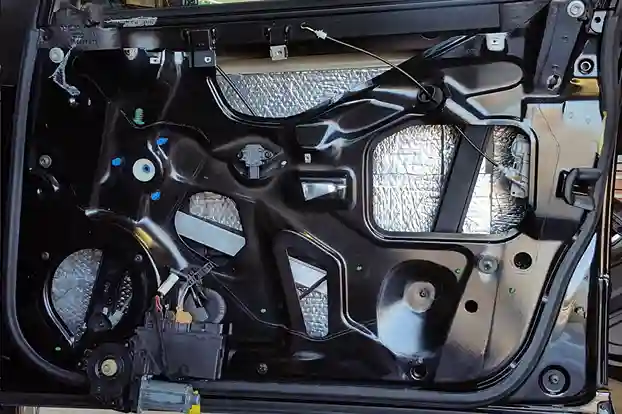
For the first layer of auto floor sound insulation, a Master reaches for a high-quality butyl rubber mat. A Master knows that 2026-spec mats like Noico 80 mil or Dynamat Xtreme use an aluminum foil face as an installation indicator. To achieve AutoFix Mastery, you don’t need $100\%$ coverage. Covering $25\%$ to $50\%$ of the center of a flat metal panel is often enough to change its “resonant frequency” from a loud clang to a dull thud.
2. The Airborne Specialist: 3M Thinsulate
To achieve AutoFix Mastery in van conversion sound deadening, 3M Thinsulate (Acoustic Insulation SM series) is the gold standard. Unlike open-cell foams that act like a sponge for condensation, Thinsulate is made of polyester and polypropylene fibers that resist moisture. A Master knows this is the secret to car bonnet sound insulation; it absorbs the high-pitched “ticks” of fuel injectors and turbo spooling while providing a thermal blanket for the engine.
3. The Firewall & Floor: Mass Loaded Vinyl (MLV)
If you are soundproofing a flat floor in a noisy 4×4, you need MLV. A Master knows that vibration mats don’t block noise; they only stop the metal from making it. To block the actual sound of the tires on the pavement, you need a “limp mass” barrier. A Master installs MLV over a layer of closed-cell foam (the decoupler) to create a “floating” floor that traps sound waves between the vinyl and the steel.
4. The Bonnet & Engine Bay Protocol
For car bonnet sound deadening, a Master uses a specialized “hood liner” with a reinforced foil face. A Master knows that standard butyl mats can melt or peel if exposed to direct engine heat. To achieve AutoFix Mastery, always clean the underside of the bonnet with degreaser before applying car damping heat and sound insulation sheets to ensure the adhesive survives 100°C engine temperatures.
Master’s Tech Tip: The “Knuckle-Test” Protocol
To achieve AutoFix Mastery, let your ears find the weak spots. Master Tip: Before applying any car insulation sheet, go around the vehicle and “rap” your knuckles on every metal surface. A Master knows that a “hollow” sound indicates a panel that needs a damping mat. Areas that sound “solid” (like reinforced pillars) don’t need heavy mats—save that weight for the large, flat expanses of the doors and roof to maintain your fuel efficiency.
[ 🏁 SILENCE THE ROAD – SHOP SOUND DEADENING ON AMAZON ]
Final Verdict: The Guardian of the Silent Cabin
Soundproofing is the intersection of physics and comfort. Whether you are performing a van conversion or upgrading your car audio dampening, prioritize “Layering” over “Thickness.” In the world of AutoFix Mastery, we prioritize Dynamat for vibration, 3M for absorption, and MLV for blocking.
Master the wave. Master the silence. Be the master of the automotive sound barrier.
Disclosure: As an Amazon Associate, I earn from qualifying purchases. Acoustic precision for a master-maintained machine!