Breaks down the essential investment for every electric vehicle owner: the Home EV Charger Installation. In 2026, as EV adoption reaches new heights, the focus has shifted from “can I charge at home?” to “how fast can I charge?” While a standard Level 1 (120V) outlet is free, it only adds about 3–5 miles of range per hour. To achieve true convenience, most owners are opting for Level 2 (240V) stations, which can fully recharge a typical long-range battery overnight in 4 to 8 hours.
To achieve AutoFix Mastery, we treat the installation as a “future-proofing” project. The goal isn’t just to power today’s car, but to ensure your electrical panel and wiring can handle the higher 48A or 80A demands of the next generation of electric trucks and SUVs.
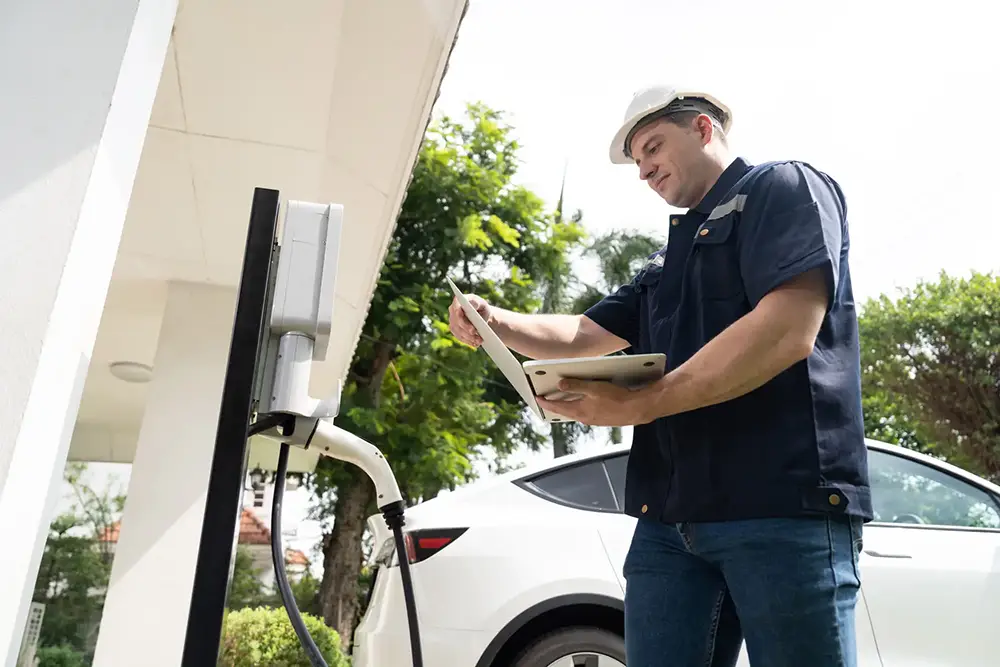
The Power Shift: EV Charger Installation Cost Guide 2026
[ ⚡ CLICK HERE TO SHOP LEVEL 2 HOME CHARGERS ]
2026 Cost Breakdown: What to Expect
In the world of AutoFix Mastery, costs are split into two categories: the Hardware (the unit itself) and the Installation (labor, permits, and materials).
| Component | Typical Cost (2026) | Mastery Level Detail |
| Charger Hardware | $400 – $900 | Smart units with WiFi/Apps are now the 2026 standard. |
| Electrical Labor | $500 – $1,500 | Varies based on the distance from the panel to the garage. |
| Permits & Inspection | $100 – $350 | Mandatory for safety and to maintain your home insurance. |
| Panel Upgrade | $1,500 – $3,500 | Only required if your current panel is full (under 200A). |
| Total (Average) | $1,200 – $2,800 | The Sweet Spot: Most modern homes fall in this range. |
Mastery Deep Dive: The Installation Pillars
1. The “Distance” Factor
For AutoFix Mastery, location is everything. Copper prices in 2026 remain a major cost driver. If your electrical panel is on the opposite side of the house from your garage, the cost of heavy-duty 6-gauge wire and conduit can add $500 to $1,000 to your quote. A Master always looks for the shortest possible path between the main breaker and the charging port.
2. Hardwired vs. Plug-In (NEMA 14-50)
A Master knows the difference in reliability. A Plug-In charger (using a 240V outlet) is easier to swap if the unit fails. However, a Hardwired installation is the 2026 pro choice because it allows for higher amperage (48A+) and eliminates a potential point of failure—the outlet itself—which can occasionally melt under the sustained high heat of EV charging.
3. The “Smart Load” Solution
To achieve AutoFix Mastery, if your panel is full, don’t rush into a $3,000 upgrade. In 2026, Smart Load Managers (like the DCC-9) are a “hack” that allows a charger to share a circuit with another large appliance (like a dryer). The system automatically pauses the car charger if the dryer is running, saving you thousands in infrastructure costs.
Master’s Tech Tip: The “Sunset” Tax Credit
To achieve AutoFix Mastery, timing is critical. In the United States, the Federal 30C Tax Credit (which covers 30% of hardware and installation up to $1,000) is currently scheduled to expire on June 30, 2026. If you are planning an installation, completing the project before this “cliff” can effectively lower your out-of-pocket cost by nearly a third.
[ 🏁 FUTURE-PROOF YOUR GARAGE – SHOP EV INSTALL KITS ON AMAZON ]
Final Verdict: The Gas Station in Your Garage
Installing an EV charger is the ultimate upgrade for any modern home. In the world of AutoFix Mastery, we believe that the convenience of “waking up with a full tank” far outweighs the initial setup cost. By choosing a high-quality 48A unit and ensuring a code-compliant installation, you aren’t just charging a car—you are increasing your home’s value and taking total control of your energy future.
Master the power. Master the panel. Be the master of the charge.
Disclosure: As an Amazon Associate, I earn from qualifying purchases. High-voltage precision for a master-maintained machine!